Vietnam and Cambodia Grand Journey

Tour Code: SGJ075-KHVN
Vietnam and Cambodia Grand Journey

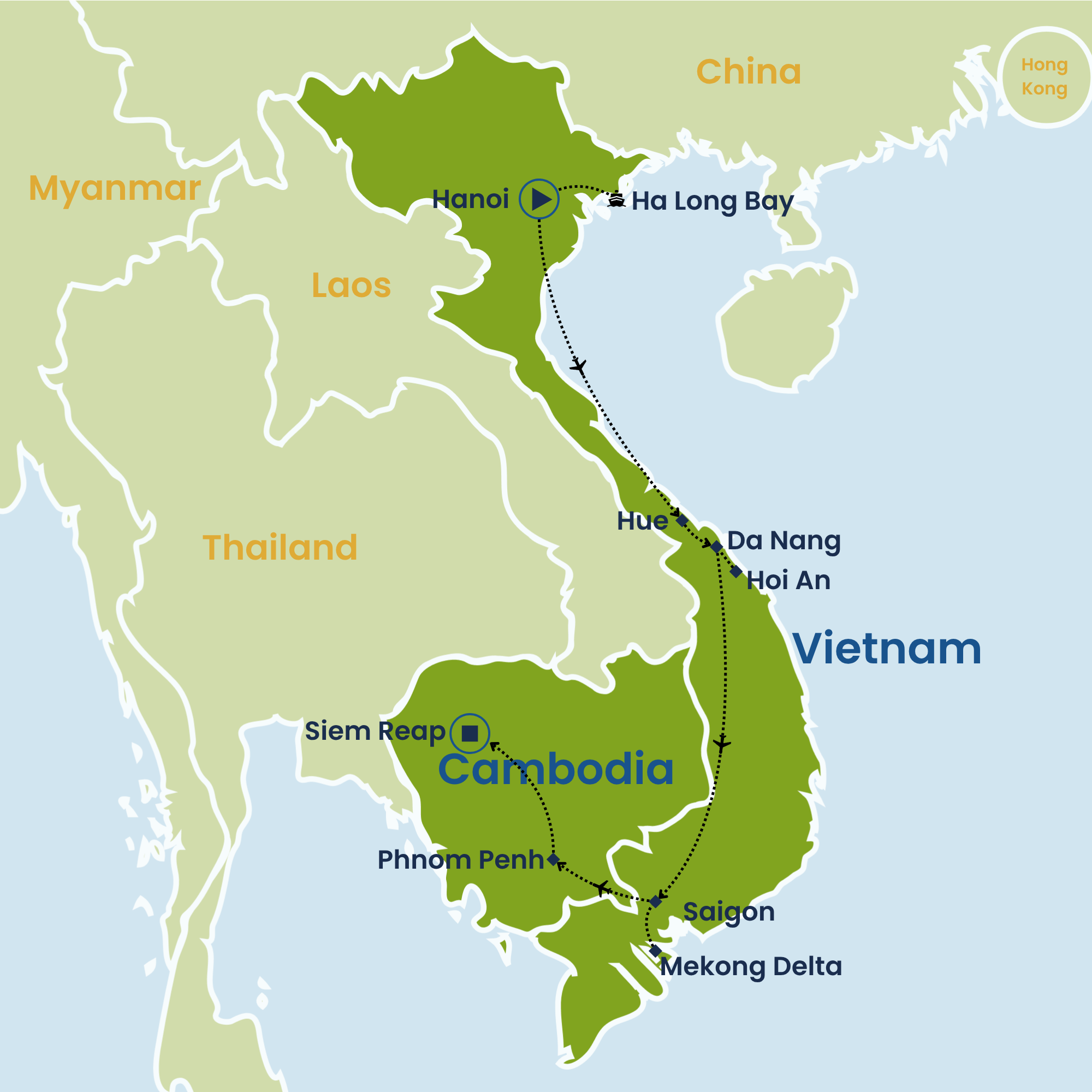
This extensive tour offers a sophisticated exploration of Vietnam and Cambodia’s most iconic destinations. Beginning in Hanoi, the journey unfolds through the vibrant streets and historical landmarks before sailing the spectacular Halong Bay. Travelers then venture south through the ancient imperial city of Hue, the charming UNESCO town of Hoi An, and the energetic metropolis of Ho Chi Minh City with its surrounding Mekong Delta. Crossing into Cambodia, the itinerary continues with immersive visits to Phnom Penh’s cultural sites and a scenic overland transfer to the floating villages near Siem Reap. The grand finale celebrates the majestic temples of Angkor, including dawn at Angkor Wat and the atmospheric ruins of Beng Mealea. This tour balances historical insight, local encounters, and serene landscapes, carefully paced with private transport and expert guidance for an engaging premium experience.

Insider Experiences

Vietnam and Cambodia Grand Journey

Itinerary Details


Day 1
Hanoi Arrival

Upon arrival in Hanoi, you will be warmly welcomed by your guide and transferred to your hotel. Take time to settle in and begin immersing yourself in the atmosphere of Vietnam’s lively capital. With its tree-lined boulevards, vibrant street life, and rich history, Hanoi serves as the ideal starting point for your journey through the country. The remainder of the day is yours to relax or begin exploring at your own pace.

Overnight in Flower Garden Hotel or similar.

Day 2
Hanoi (B)

This morning, meet your guide at your hotel and depart on your tour after breakfast. Your first stop will be the popular Hoan Kiem Lake, situated in the heart of Hanoi city, followed by a visit to Dong Xuan market. Next, explore the Ho Chi Minh complex, which comprises Ba Dinh Square, the Presidential Palace (for outside photo stops), and Ho Chi Minh’s private residence from 1954 until 1969. The wooden ethnic minority style house, built on stilts, is surrounded by peaceful gardens. Within the same complex, you will see the One Pillar Pagoda, founded by King Ly Thai To in 1049, which has become an important symbol for the people of Hanoi. Following your own lunch, continue to the Temple of Literature, Vietnam’s first university, constructed in 1070. Its gardens and well-preserved architecture offer a glimpse into Vietnam’s past. Next, visit Hoa Lo Prison, formerly known as the “Hanoi Hilton” during the American war. Your tour will also include the historical St Joseph’s Cathedral. The last stop of the day before returning to your hotel is the Opera House, followed by a stroll around the bustling Old Quarter. Here, find a street-side café and enjoy a cup of traditional Vietnamese coffee, especially egg coffee, while observing the lively street life.

Overnight in Flower Garden Hotel (4 Star) or similar.

Day 3
Hanoi to Ha Long Bay (B/L/D)

After breakfast, you will be met at your hotel at 7:30 AM and transferred by shuttle bus from Hanoi to Halong City, the gateway to Ha Long Bay. Upon arrival, board a well-appointed junk boat and enjoy a delicious lunch as you begin cruising among some of the 3,000 islands rising from the sea. In the evening, retreat to your private cabin or relax on the main deck or at the bar.

Overnight in Victory Star Cruise or similar.

Day 4
Ha Long Bay to Hue (B)

Start your day with a sunrise Tai Chi session on the sundeck, followed by brunch on board. Cruise back to port and disembark. Travel by shuttle bus to Hanoi and transfer to the airport, where you will board your flight to Hue, the former imperial capital. Upon arrival, transfer to your hotel for check-in and an afternoon at leisure.

Overnight in Alba Spa Hotel (4 Star) or similar.

Day 5
Hue to Hoi An (B)

Begin with a half-day city tour of Hue, starting at the tomb of the fourth emperor of the Nguyen Dynasty, Tu Duc, set beautifully among lakes and frangipani trees. Continue to the Citadel, the impressive former home of the Nguyen emperors and a UNESCO World Heritage site, although much of it was damaged during the Tet Offensive in 1968 and is currently under restoration. Finish your tour with a visit to Thien Mu Pagoda, Hue’s oldest and most revered temple. After the tour, travel to Hoi An, crossing the scenic Hai Van Pass, noted as Vietnam's geographical and psychological boundary between north and south, famous for its summit often cloaked in clouds. Upon arrival, check in at your hotel. The evening is free to explore Hoi An at your leisure.

Overnight in Hoi An Central Boutique Hotel (4 Star) or similar.

Day 6
Hoi An (B)

Begin your day with a guided walking tour of Hoi An’s UNESCO World Heritage-listed Old Town. Once Vietnam’s most active trading center, the architecture reflects a blend of Chinese, Japanese, Portuguese, French, and British influences. Visit a traditional ancient house, the Hoi An Museum, a Chinese Assembly Hall, Chau Ong pagoda, and the Japanese Covered Bridge. The tour concludes in the Old Town, where you can spend additional time at your leisure.

Overnight in Hoi An Central Boutique Hotel (4 Star) or similar.

Day 7
Hoi An to Saigon (B)

After breakfast, transfer to Danang for your flight to Saigon. Upon arrival, your guide and private car will take you to the Cu Chi Tunnels. Watch a short documentary explaining the history of the tunnel network before exploring the tunnels as used by the communist guerrillas during the Vietnam War. The extensive tunnel system stretches over 250 km across three underground levels, serving as hiding spots, communication and supply routes, hospitals, and living quarters. While much of the network has been reconstructed above ground, you may choose to go underground to better understand the conditions experienced by the Viet Cong. Return to Saigon afterward and check in to your hotel. Spend the remainder of the day enjoying Saigon’s vibrant atmosphere.

Overnight in Paragon Hotel (4 Star) or similar.

Day 8
Saigon (B/L/D)

Meet your guide at 8:00 AM for a full-day tour south of Ho Chi Minh City to Ben Tre in the Mekong Delta, known as Vietnam's most fertile and productive agricultural region. Board a boat to explore the Mekong River and its narrow canals, observing the local way of life. Visit a traditional brick-making factory that uses ancient kiln techniques, a coconut processing factory, and a local family home where mats are woven from natural materials. Enjoy a pedicab ride to a restaurant for lunch featuring local specialties including Elephant Ear Fish. Return north with a stop at a Cao Dai pagoda, representative of a uniquely Vietnamese religion blending Buddhism, Taoism, Confucianism, Hinduism, Christianity, and Islam. Return to Ho Chi Minh City late afternoon. In the evening, join your group for a farewell dinner at HOME Vietnamese Sai Gon, an authentic local restaurant.

Overnight in Paragon Hotel (4 Star) or similar.

Day 9
Saigon to Phnom Penh (B)

Begin the morning with a walking tour of Saigon’s historic city landmarks including Dong Khoi Street, the Rex Hotel, Municipal Theatre, Hotel de Ville, Nguyen Hue Boulevard, Post Office, Notre Dame Cathedral, and the Reunification Palace (outside only). Visit the site of the former US Embassy (now the US consulate) and the War Remnants Museum. Later, explore Ba Chieu wholesale market in Saigon’s Binh Thanh district and visit the Ngoc Hoang (Jade Emperor) Pagoda, known for its intricate sculptures and woodcarvings. Return to your hotel where the city tour concludes. You will then be transferred to the airport for your flight to Phnom Penh. Upon arrival, transfer to your hotel. Enjoy free time until the welcome drinks, where your Tour Leader will provide important trip information.

Overnight in Sun and Moon Urban Hotel or similar.

Day 10
Phnom Penh (B)

Explore Phnom Penh by Cyclo (bicycle rickshaw), beginning at Wat Phnom, the birthplace of the city. Visit the Royal Palace, residence of King Norodom Sihamoni, with its renowned Silver Pagoda. Nearby is the National Museum, home to a comprehensive collection of Khmer art. Visit the Central Market, a vast complex with stalls selling a wide range of goods. In the afternoon, travel by vehicle to the Toul Sleng Museum, the former high school transformed into an interrogation and torture center during the Khmer Rouge regime.

Overnight in Sun and Moon Urban Hotel (4 Star) or similar.

Day 11
Phnom Penh to Siem Reap (B)

Depart Phnom Penh for Siem Reap by road, stopping en route at the Skun market, known for its range of spiders and insects, and the stone mason village near Santuk. Before arriving in Siem Reap, visit the floating village of Kampong Phluk, which consists of three villages built on stilts. These villages are flooded for approximately half the year, offering visits by boat through mangrove forests that support a diverse ecosystem. When water levels allow, take a rowing boat through this landscape. Continue to Siem Reap and check into your hotel. The rest of the day is at leisure.

Overnight in Steung Siem Reap Hotel (4 Star) or similar.

Day 12
Siem Reap (B)

Start early with a visit to Angkor Wat to witness sunrise over the temple complex. Explore the bas-reliefs and central structures before enjoying breakfast at a nearby local restaurant. Continue to the Southern Gate of Angkor Thom, the 'Great City' established by King Jayavarman VII, noted for the giant stone faces of Avalokiteshvara. Visit the state temple of Bayon at the center of this citadel, featuring hundreds of stone faces. Additional sites include the Terrace of Elephants and the Terrace of the Leper King. In the afternoon, explore 11th-century temples Baphuon and Phimeanakas, followed by Ta Prohm, famous for its massive tree roots enveloping the temple’s stone walls. Return to your hotel in Siem Reap.

Overnight in Steung Siem Reap Hotel (4 Star) or similar.

Day 13
Siem Reap (B/L/D)

Begin your day with a visit to Damdek local market, followed by a trip to Beng Mealea temple. Beng Mealea is constructed from squared sandstone blocks, partly reclaimed by vegetation, and decorated with pediments illustrating Ramayana scenes. Although predominantly Buddhist, the site contains Hindu iconography and a notable Bodhisattva Lokeshvara statue now kept at the Angkor Conservancy. Enjoy lunch at a local restaurant before visiting Banteay Srei temple. En route back, stop at the Landmine Museum to see defused mines and learn about mine clearance efforts worldwide. Visit a local village engaged in sugar palm production. In the evening, enjoy a Khmer farewell dinner at a local restaurant.

Overnight in Steung Siem Reap Hotel (4 Star) or similar.

Day 14
Siem Reap Departure (B)

Transfer to the airport for your onward journey.


Travel Notes

Hanoi to Ha Long Bay

Approx. 170 km / Approx. 4 hours by road.

Ha Long Bay to Hue

Road approx. 170 km + flight approx. 600 km / Road approx. 4 hours + flight approx. 1.5 hours by road and flight.

Hue to Hoi An

Approx. 145 km / Approx. 3 to 4 hours by road.

Hoi An to Saigon

Approx. 900 km / Approx. 1.5 hours by flight.

Saigon to Phnom Penh

Approx. 230 km / Approx. 1 hour by flight.

Phnom Penh to Siem Reap

Approx. 320 km / Approx. 6 to 7 hours by road.

Travel between major cities in Vietnam and Cambodia involves a mix of road and short domestic flights due to varying distances and terrain. Roads, especially rural highways and regional connections, can be variable in quality, so expect differing comfort levels. Flights efficiently cover longer legs, such as Hue to Saigon and Saigon to Phnom Penh, helping to reduce journey times. Road journeys through remote or rural areas, like Phnom Penh to Siem Reap, may experience slower traffic and basic roadside facilities. Seasonality, particularly during monsoon months, can affect road conditions and transfer times.

All travel distances and times are indicative only and may vary depending on traffic, weather, routing and local conditions.


Destination Information

Hanoi

Hanoi presents a distinctive blend of historical depth and urban vitality set along the banks of the Red River in northern Vietnam. The city’s compact core features narrow streets lined with low-rise buildings that reflect centuries of architectural influence, from traditional Vietnamese to French colonial styles. At its heart, a tranquil lake punctuates the dense urban fabric, offering a quiet contrast to the surrounding bustle. Hanoi’s streets bustle with a mix of motorbikes, street vendors, and local commerce, creating a textured everyday scene that reveals the city’s ongoing evolution. Cultural landmarks are woven into the urban landscape, with a temple dedicated to Confucian learning standing amid busy neighborhoods, and a solemn mausoleum commemorating a key figure in Vietnam’s modern history. The city’s location within the fertile Red River Delta shapes its character, linking it to a wider agricultural region while maintaining a distinctly urban pace. This combination of water, history, and active street life defines Hanoi as a place where tradition and contemporary life coexist visibly and tangibly.

Saigon

Saigon presents a dense urban fabric where colonial-era architecture and modern developments coexist along the banks of the Saigon River. The city’s streets pulse with a mix of motorbikes, street vendors, and markets, reflecting its role as a commercial and cultural center in southern Vietnam. Its layered past is visible in landmarks such as the Notre-Dame Cathedral Basilica, built with red bricks imported from France, which contrasts with the nearby War Remnants Museum that documents the impact of conflict on the region. The bustling Ben Thanh Market offers a window into everyday life, with stalls selling local produce, textiles, and street food amid a lively atmosphere. Beyond the city’s core, the Cu Chi Tunnels extend the historical narrative into the surrounding countryside, revealing the intricate underground network used during wartime. Saigon’s combination of waterways, historic sites, and vibrant street scenes creates a setting that captures both the resilience and complexity of Vietnam’s urban experience.

Hoi An

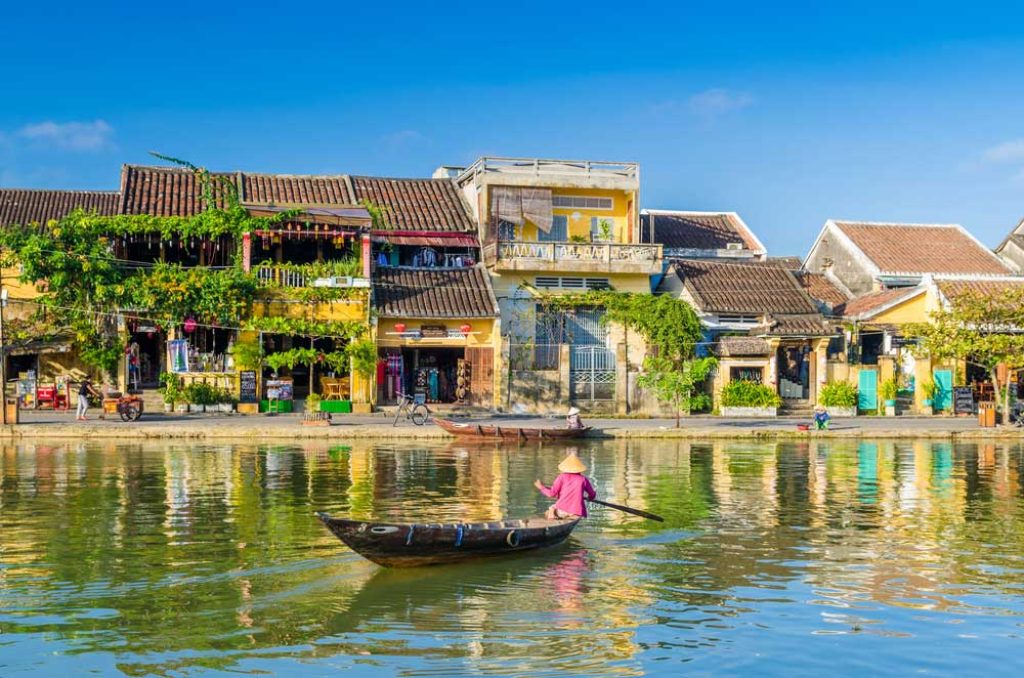
Hoi An is a compact town set along the gentle curves of the Thu Bon River in Vietnam’s central coastal region, where narrow streets and low-rise buildings create an intimate urban fabric shaped by centuries of trade and cultural exchange. Its architecture reflects a blend of local and foreign influences, with wooden shop houses and tiled roofs lining quiet lanes that invite slow exploration. The town’s scale and layout encourage a pedestrian pace, fostering a close connection between everyday life and the preserved historic environment. Traditional crafts remain part of daily activity, visible in workshops where artisans shape lanterns that light the streets after dusk, adding a warm, tangible element to the town’s atmosphere. The Japanese Covered Bridge, a distinctive structure linking parts of the old quarter, exemplifies the layering of cultural influences and the integration of functional design with aesthetic detail. Beyond the built environment, the nearby river and coastal landscape contribute to Hoi An’s character, grounding it in a region known for its fertile plains and maritime heritage. This combination of architectural heritage, artisanal practice, and natural setting defines Hoi An’s appeal as a place where history and local life coexist closely.

Danang

Danang is a coastal city where urban development meets natural landscapes, offering a distinctive blend of modernity and tradition along Vietnam’s central coastline. Its broad sandy shores, exemplified by My Khe Beach, provide a relaxed environment that contrasts with the city’s growing skyline and bustling streets. The nearby Marble Mountains rise sharply from the flat coastal plain, their limestone peaks dotted with caves and pagodas that reflect centuries of spiritual and cultural activity. The Han River flows through the city, with the Han River Bridge serving as a functional and visual landmark that connects different parts of Danang while illuminating the cityscape after dark. The Cham Museum houses an extensive collection of sculptures and artifacts from the ancient Champa civilization, anchoring Danang’s historical significance amid its contemporary urban fabric. The city’s layout balances waterways, open spaces, and dense residential areas, creating a setting where everyday life unfolds alongside historical sites and natural features. Danang’s atmosphere is defined by this coexistence of coastal leisure, cultural heritage, and ongoing urban growth, making it a place where visitors can engage with both Vietnam’s past and present.

Hue

Hue, situated on the banks of the Perfume River in central Vietnam, serves as a pivotal cultural waypoint on many travel routes through the country’s historical heartland. The city’s layout reveals a deliberate symmetry with its expansive Citadel, constructed from laterite and brick, anchoring the urban fabric. Surrounding the fortified imperial complex, narrow streets bustle with everyday markets, where locals trade fresh produce and traditional crafts, highlighting a contrast between the city’s monumental past and its present-day rhythms. Beyond the urban core, the surrounding plains and nearby Annamite Mountains frame Hue within a diverse landscape that underscores its enduring role as a former imperial capital and a living community shaped by both tradition and the natural environment.

Halong City

Halong City occupies a distinctive coastal landscape where limestone karsts rise sharply from emerald waters, shaping a setting that blends natural grandeur with local livelihoods. The city’s character is deeply influenced by its proximity to Halong Bay, whose dramatic seascape of towering islands and hidden inlets extends into the surrounding waters. Along the shoreline, small fishing villages maintain traditional practices, offering a glimpse into daily life shaped by the sea. Inland, the Quang Ninh Museum provides a structured narrative of the region’s cultural and geological heritage, complementing the natural environment with historical context. The area’s cave systems add another layer of geological interest, with intricate formations that reveal the slow processes shaping the landscape over millennia. Nearby coastal wetlands support diverse ecosystems, reflecting the balance between human activity and nature. Together, these elements create a place where the physical environment and community coexist, marked by a measured pace and a focus on maritime culture rather than urban bustle. This combination of striking natural features and enduring local traditions defines the experience of Halong City.

Phnom Penh

Phnom Penh unfolds along the banks of the Mekong River, where wide boulevards and colonial-era buildings meet bustling markets and riverside promenades. The city’s urban fabric reflects its complex history, with grand structures like the Royal Palace Complex standing amid lively neighborhoods where daily commerce and street life thrive. Phnom Penh’s streets reveal layers of the past, from the ornate spires of Wat Phnom Temple to the sobering exhibits of the Tuol Sleng Genocide Museum, which confront visitors with the city’s difficult twentieth-century history. The Central Market Building anchors a vibrant commercial district, its distinctive art deco architecture framing a maze of stalls selling everything from fresh produce to textiles. Along the riverfront, locals gather to socialize and relax, creating a dynamic public space that contrasts with the city’s more formal landmarks. This blend of historical depth, architectural variety, and active urban life gives Phnom Penh a distinctive character within Cambodia, inviting visitors to engage with both its cultural heritage and contemporary rhythms.

Siem Reap

Siem Reap is a city where ancient history and everyday life coexist amid a landscape shaped by waterways and lush greenery. Its streets reveal a blend of traditional Khmer architecture and modest urban development, reflecting a community rooted in local customs while engaging with growing tourism. The city’s proximity to the vast Tonle Sap Lake influences both its economy and atmosphere, with floating villages and fishing activities visible beyond the urban edges. Central to Siem Reap’s identity is the nearby Angkor Archaeological Park, where temple ruins rise from dense forest, offering insight into the grandeur of the Khmer Empire. This historical presence contrasts with the lively Old Market area, where vendors sell local crafts and produce, providing a glimpse into contemporary daily life. Beyond the city limits, Phnom Kulen National Park offers natural landscapes and spiritual sites, reinforcing the region’s connection to Cambodia’s cultural heritage. Together, these elements create a destination that balances the weight of its past with the rhythms of present-day community life.

Mekong Delta

The Mekong Delta unfolds as a vast, intricate landscape where waterways carve through fertile plains, shaping both the environment and the livelihoods of its inhabitants. This region is distinguished by its extensive network of rivers and canals, which sustain a rich agricultural system dominated by rice cultivation. The slow-moving waters foster diverse wetlands that support a variety of plant and animal species, creating a distinctive ecosystem within the tropical climate. Along these waterways, communities engage in traditional practices such as floating markets, where commerce and daily life merge on boats laden with local produce and goods. The built environment reflects practical adaptation to the waterborne setting, with stilted houses and open-air workshops producing handicrafts rooted in local materials and techniques. The interplay between natural abundance and human activity defines the Delta’s character, offering insight into a way of life closely tied to the rhythms of the river and the land. This combination of ecological richness and cultural tradition makes the Mekong Delta a place where the landscape and its people are inseparable.

Kampong Phluk

Kampong Phluk is a village set along the edges of the Tonle Sap floodplain, where seasonal waters shape both the landscape and the way of life. The settlement’s distinctive stilted houses rise above the water during the rainy season, reflecting an adaptation to the fluctuating environment. This elevated architecture allows residents to live in close harmony with the floodplain ecosystem, which supports a rich variety of fish and wildlife. Daily life here revolves around fishing, with traditional methods still practiced, offering insight into the sustainable relationship between the community and its natural surroundings. The village’s proximity to floating markets adds a layer of commercial activity, where boats laden with goods navigate the waterways, blending livelihood with local culture. Kampong Phluk’s atmosphere is quiet and measured, shaped by the rhythms of water levels and the rural Cambodian lifestyle that persists amid the seasonal changes. The interplay between the natural environment and human settlement creates a setting that is both practical and deeply connected to the region’s ecological cycles.

Beng Mealea

Beng Mealea is a remote temple complex set deep within dense jungle, where the ruins emerge from thick vegetation and fallen trees, creating a striking contrast between nature and ancient stonework. The site offers a tangible sense of Cambodia’s historical depth, with its partially collapsed structures revealing the scale and craftsmanship of Khmer architecture. Unlike more restored temples, Beng Mealea retains a raw, unfinished quality that invites exploration and reflection on the passage of time. The sprawling layout is marked by intricately carved sandstone blocks, corridors, and courtyards that blend into the surrounding forest, giving the area a quiet, secluded atmosphere. This environment highlights the temple’s original context as part of the Khmer Empire’s extensive religious and cultural landscape. Visitors experience a setting where history and nature coexist closely, providing insight into the region’s architectural heritage and the enduring presence of the jungle. Beng Mealea’s accessibility from Siem Reap allows for a focused visit to a site that feels both ancient and alive within its natural surroundings.


Hotel Information

Flower Garden Hotel

Nestled in a tranquil enclave, Flower Garden Hotel offers a refined retreat designed for discerning travelers seeking understated luxury. This elegant four-star establishment harmonizes modern comfort with a serene atmosphere, inviting guests to unwind amid lush landscaped gardens that inspire calm and contemplation. Thoughtful amenities and attentive service ensure a personalized experience, while spacious rooms feature tasteful decor that blends natural elements with contemporary design. With its intimate scale and quiet setting, Flower Garden Hotel stands apart as a sanctuary where sophistication meets genuine warmth—perfect for those who value both privacy and an effortless connection to nature. Whether for business or leisure, the hotel’s seamless blend of comfort and tranquility creates a memorable stay that feels both exclusively tailored and naturally inviting.

Victory Star Cruise

Victory Star Cruise offers an immersive journey along the Mekong River, blending refined comfort with authentic cultural encounters. This intimate vessel features elegantly appointed cabins and a welcoming atmosphere that reflects the region’s rich heritage. Guests are invited to explore vibrant local markets, timeless temples, and traditional villages, all curated to provide meaningful connections beyond typical sightseeing. Onboard, expert guides and attentive service create a seamless experience, balancing relaxation with enriching exploration. Every detail, from the carefully crafted cuisine to the thoughtfully designed public spaces, emphasizes a harmonious blend of luxury and authenticity, setting Victory Star Cruise apart as a distinctive passage through Southeast Asia’s heart.


Inclusions & Exclusions

Included

Arrival and Departure Transfers
English-speaking Tour Guide
Entrance fees for locations specified
Internal Flights as specified in itinerary
Meals as stated (B = Breakfast; L = Lunch; D = Dinner)

Not Included

Overnight on Cruise as stated
Tipping for Guide and Driver
Transport in Air-conditioned Vehicles
Accommodation in Stated Hotels or similar
SGN-PNH flight included
Early Check-in and Late Check-out
International Flights
Meals not stated in itinerary
Porters
Travel Insurance
Visa Fees
Personal Expenses (Laundry, Mini-bar, Phones, Drinks, etc.)

01 April 2026 to 31 March 2027

Date Start Date End Date TWN/DBL Share SGL Room
05/08/2026 Wednesday, 05 August 2026 Tuesday, 18 August 2026 2289 2790
19/08/2026 Wednesday, 19 August 2026 Tuesday, 01 September 2026 2289 2790
02/09/2026 Wednesday, 02 September 2026 Tuesday, 15 September 2026 2289 2790
16/09/2026 Wednesday, 16 September 2026 Tuesday, 29 September 2026 2289 2790
30/09/2026 Wednesday, 30 September 2026 Tuesday, 13 October 2026 2289 2790
14/10/2026 Wednesday, 14 October 2026 Tuesday, 27 October 2026 2340 2891
28/10/2026 Wednesday, 28 October 2026 Tuesday, 10 November 2026 2340 2891
11/11/2026 Wednesday, 11 November 2026 Tuesday, 24 November 2026 2340 2891
25/11/2026 Wednesday, 25 November 2026 Tuesday, 08 December 2026 2340 2891
09/12/2026 Wednesday, 09 December 2026 Tuesday, 22 December 2026 2340 2891
23/12/2026 Wednesday, 23 December 2026 Tuesday, 05 January 2027 2340 2891
06/01/2027 Wednesday, 06 January 2027 Tuesday, 19 January 2027 2340 2891
20/01/2027 Wednesday, 20 January 2027 Tuesday, 02 February 2027 2340 2891
03/02/2027 Wednesday, 03 February 2027 Tuesday, 16 February 2027 2340 2891
17/02/2027 Wednesday, 17 February 2027 Tuesday, 02 March 2027 2340 2891
03/03/2027 Wednesday, 03 March 2027 Tuesday, 16 March 2027 2340 2891
17/03/2027 Wednesday, 17 March 2027 Tuesday, 30 March 2027 2340 2891
31/03/2027 Wednesday, 31 March 2027 Tuesday, 13 April 2027 2340 2891
Kavaya Travel · sales@kavaya.travel